
This spring has brought dramatic weather swings, temperature ups and downs, and more severe conditions than usual.
While headlines often focus on strong storms and near-record temperatures, the processes behind these sudden changes impact more than you might expect.
Dense fog has appeared not just this weekend, but the previous one as well — fog that a News 5 viewer, Tricia in Lake County, described as something that “looked like steam.”
Sharp drops from near-record, summer-like warmth to winter-like chill help form fog, especially near the lake.
As air temperatures fall below the water temperature of Lake Erie, the warmer water releases moisture into the colder air above it, where it becomes trapped.
When this warm, moist air stays close to the ground above the water, it forms what’s known as steam fog.
These shifting conditions, from warm to cold, make fog more visible, particularly near the lake. But when temperatures shift from cold to warm, a different phenomenon can occur.
With the ongoing temperature roller coaster, another significant warm-up is expected Monday into early Tuesday. Not all warm-ups behave the same, and this setup is especially favorable for something called tropospheric ducting.
Tropospheric ducting, often shortened to “tropo,” occurs when TV and radio signals travel much farther than usual due to specific atmospheric conditions.
So what causes this, and why might people in Northeast Ohio pick up Canadian stations overnight?
Instead of a temperature difference between water and air, this situation involves a temperature inversion in the atmosphere. Normally, air gets colder as you go higher.
However, during this warm surge, the air above the ground warms faster than the air at the surface. This creates a layer where warmer, denser air sits above cooler air, causing TV and radio signals to bend back toward the ground instead of escaping into space.
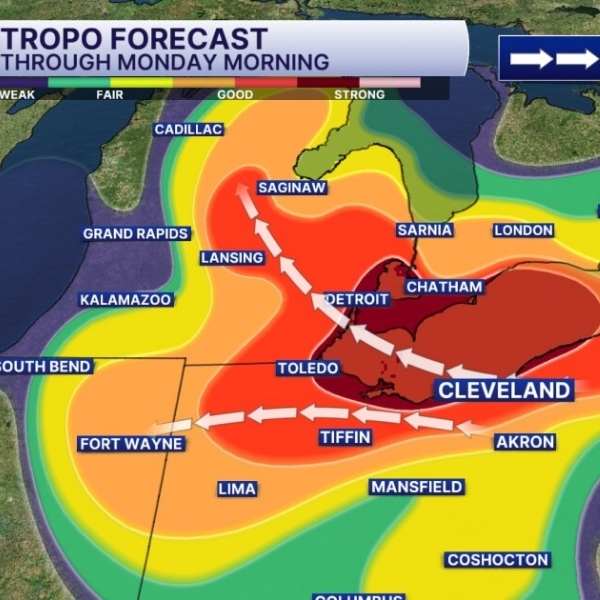
This bending can continue for dozens or even hundreds of miles wherever the inversion exists, which is expected across much of Northern Ohio, extending into Michigan and eastern Indiana.
Based on current forecasts and atmospheric data, the best chance to receive distant stations will be just before sunrise, between 5 and 7 a.m., with conditions fading before noon.
If you live near the lake, you might pick up stations from Detroit, Windsor, Chatham, and London by scanning your TV or tuning your FM radio. There’s even a chance of receiving signals from as far as Upper Michigan and eastern Indiana.
The most likely signal paths, or “ducts,” will follow two main directions. Coastal areas near Lake Erie are more likely to receive stations from cities north and west of Cleveland, while inland areas, especially south of the Turnpike, are more likely to pick up stations from western Ohio and eastern Indiana, with a smaller chance of signals from southern and central Ohio.






Leave a Comment