
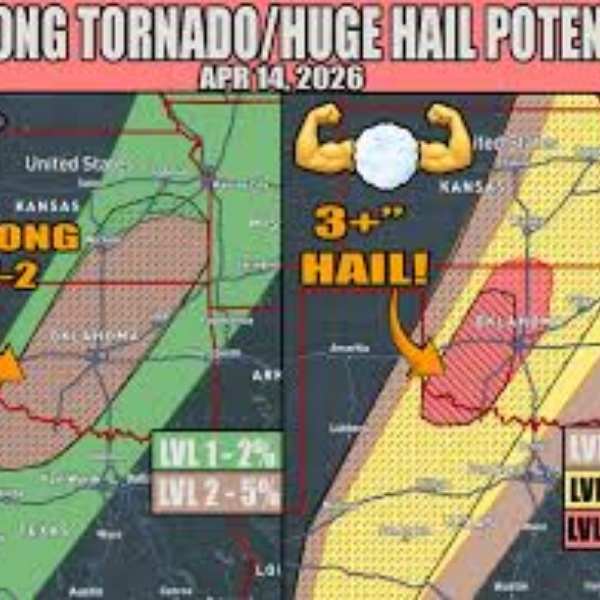
WICHITA, Kansas — Sunday, April 26 is coming into clearer focus, with the Kansas-Nebraska border stretching into north-central Oklahoma now identified as the primary target zone for what could become a high-end severe weather event. The atmosphere is building with 1,000+ J/kg MUCAPE and 40+ knot shear across a focused corridor, and any supercell that develops along the dryline Sunday afternoon could produce significant tornadoes and very large hail.
Forecasters are narrowing in on a specific zone, and that precision is what raises concern for Sunday’s threat.
The Sunday Severe Weather Target Zone
Meteorologists are focusing on a tight corridor for potential storm development:
Kansas-Nebraska border: The main bull’s-eye for surface-based storm development Sunday afternoon, where strong convergence and a dryline bulge create maximum lift
North-central Oklahoma: The southern portion of the target zone, where weaker capping increases the likelihood of surface-based storms
Southern Kansas: The Wichita corridor, positioned along the southern edge of the primary development zone
Northern Oklahoma: The Tulsa area, where stronger capping may limit storm formation, but any storm that develops could quickly intensify into a high-end supercell
Nebraska: Southern communities along the KS-NE border within the core development zone
Primary Threats Sunday
Atmospheric conditions point to a potentially dangerous setup:
Significant tornadoes — Areas from the KS-NE border into north-central Oklahoma show the highest likelihood for surface-based storm development capable of producing strong tornadoes
Very large hail — The combination of 1,000+ J/kg MUCAPE and 40+ knot shear supports supercells capable of producing hail as large as baseballs or bigger
High-end supercells — Even in areas with stronger capping, any storm that breaks through will encounter an extremely favorable environment for rapid intensification
Dryline-driven storms — The strongest surface convergence and dryline bulge near the KS-NE border will provide the most favorable conditions for storm initiation Sunday afternoon
Why the KS-NE Border Is Ground Zero Sunday
Communities near Wichita and along the Kansas-Nebraska border should understand why this region stands out as the focal point for the most dangerous storms.
Three key atmospheric factors are aligning in this area. First, stronger surface convergence is forming as the dryline develops a pronounced bulge along the KS-NE border, concentrating lift needed to initiate storms. Second, differential temperature advection at mid-levels, combined with shortwave energy, is weakening the cap across northern Oklahoma and Kansas, allowing storms to form where conditions are most favorable. Third, a powerful 500 mb jet stream is expected to move directly over the region, providing the upper-level energy needed to organize storms into rotating supercells.
The difference between northern and southern parts of the target zone is important. In north-central Oklahoma, weaker capping increases the chance of storm development, while still supporting severe weather including tornadoes and large hail. Farther north along the KS-NE border, stronger capping may limit the number of storms, but any storm that does develop could become more intense due to the highly unstable environment.
This setup reflects classic Tornado Alley dynamics. A strong cap can limit storm coverage but allows energy to build, creating the potential for fewer but more intense storms.
The dryline moisture boundary highlights where storm fuel is concentrated, marking a sharp divide between dry western air and moist Gulf air across the KS-NE border. As this boundary strengthens under peak daytime heating Sunday, the likelihood of storm initiation increases.
Multi-Day Pattern
Sunday, April 26 is part of an active eight-day severe weather pattern running from Thursday, April 23 through Monday, April 27. Sunday represents the Southern Plains phase, driven by dryline activity across Kansas and Oklahoma. By Monday, the system shifts east, bringing the primary threat into the Mississippi Valley, Tennessee, and Alabama with a large warm-sector setup. Areas in the Mid-South should monitor Sunday’s developments as conditions may intensify further the next day.
What to Watch Next
Forecasters will closely monitor several key factors:
Cap strength across northern Oklahoma and southern Kansas Sunday morning, which will determine how easily storms can develop
Dryline position and bulge formation Sunday afternoon, with sharper features increasing storm potential
Potential tornado watch issuances Sunday afternoon across the KS-NE border and north-central Oklahoma
Whether the cap breaks in northern Kansas, which could allow high-end supercells to develop
Storm reports Sunday evening as initial supercells begin producing tornadoes and large hail
Residents along the Kansas-Nebraska border, southern Nebraska, and north-central Oklahoma should prepare in advance and identify safe shelter locations before storms develop Sunday afternoon. In setups like this, conditions can escalate quickly, and waiting for warnings may reduce reaction time.






Leave a Comment