
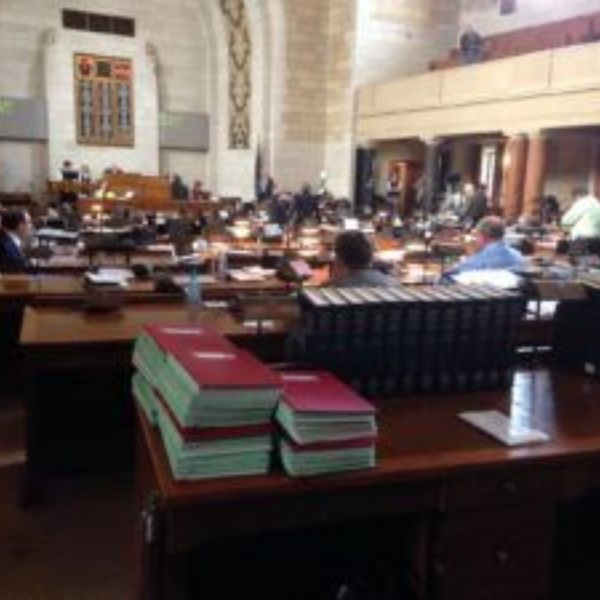
LINCOLN — Nebraska’s main budget bill failed to advance for the second consecutive time as lawmakers remained divided over controversial policy additions included outside the usual legislative process.
Legislative Bill 1071, introduced by Speaker John Arch of La Vista and led by Appropriations Committee Chair Sen. Rob Clements of Elmwood, failed Wednesday following a filibuster with a 27-15 vote. The bill needed 33 votes to end debate through a procedural step known as cloture.
Arch said he plans to bring LB 1071 back for a third attempt at this stage, where lawmakers may consider removing the disputed provisions entirely.
The bill had already stalled last week with a 19-10 vote. Historically, Nebraska budget bills have struggled to reach cloture only a handful of times, making this year’s repeated failures notable.
Gov. Jim Pillen responded briefly to the latest setback, stating, “It is the Legislature’s duty to put a balanced budget on my desk.”
At the center of the disagreement is a proposed $3.5 million private school voucher program designed to help cover tuition costs for certain K-12 students. The plan would support students affected after voters repealed a school choice law in 2024. It also includes $150,000 in administrative expenses.
Originally proposed at $7 million by Pillen, the Appropriations Committee reduced the funding amid efforts to address a projected $646 million deficit.
Clements initially removed the voucher provision before the bill’s first failure, citing insufficient support. However, lawmakers later reintroduced it through an amendment debated Wednesday.
Supporters of the voucher plan also raised concerns about another provision in the budget—LB 304—introduced by Sen. Wendy DeBoer of Bennington. The measure would permanently extend eligibility for the state’s child care subsidy program at 185% of the federal poverty level, instead of allowing it to drop to 130% in October. The proposal carries an estimated cost of $10.71 million for the current budget cycle.
Sen. Ben Hansen of Blair described the inclusion of both measures as a “bipartisan compromise,” urging lawmakers to move the bill forward despite disagreements.
“If there was a time to hold our nose a little bit, this is the time to do it,” Hansen said.
Hansen argued the voucher program would provide short-term support for low-income students until a federal tax credit program becomes available.
Opponents, however, said private schools have already committed to keeping affected students enrolled, reducing the urgency of state funding.
Sen. Tom Brandt of Plymouth maintained that removing the voucher provision is the only way to advance the budget, suggesting private donations could cover the costs instead.
“That is a solvable amount of money,” said Sen. John Fredrickson of Omaha.
Sen. Jana Hughes of Seward argued that neither the voucher program nor the child care subsidy should be included in the budget, saying both deserve separate legislative debate.
Lawmakers remain divided, with some arguing the bill cannot pass unless both provisions are included—or both are removed. Hansen indicated that upcoming debate may focus on eliminating both proposals to break the deadlock.
Meanwhile, after advancing LB 1072, the second budget bill, Nebraska’s projected deficit has been reduced to about $45 million. Legislative Fiscal Analyst Keisha Patent noted that closing the remaining gap will require additional revenue measures.
The final outcome of LB 1071 remains uncertain as lawmakers prepare for another round of debate.






Leave a Comment